
Kolini Coleman's Name Tells a Story: Why Saying It Right Matters
Jessica DuBridge
Jun 22, 2026
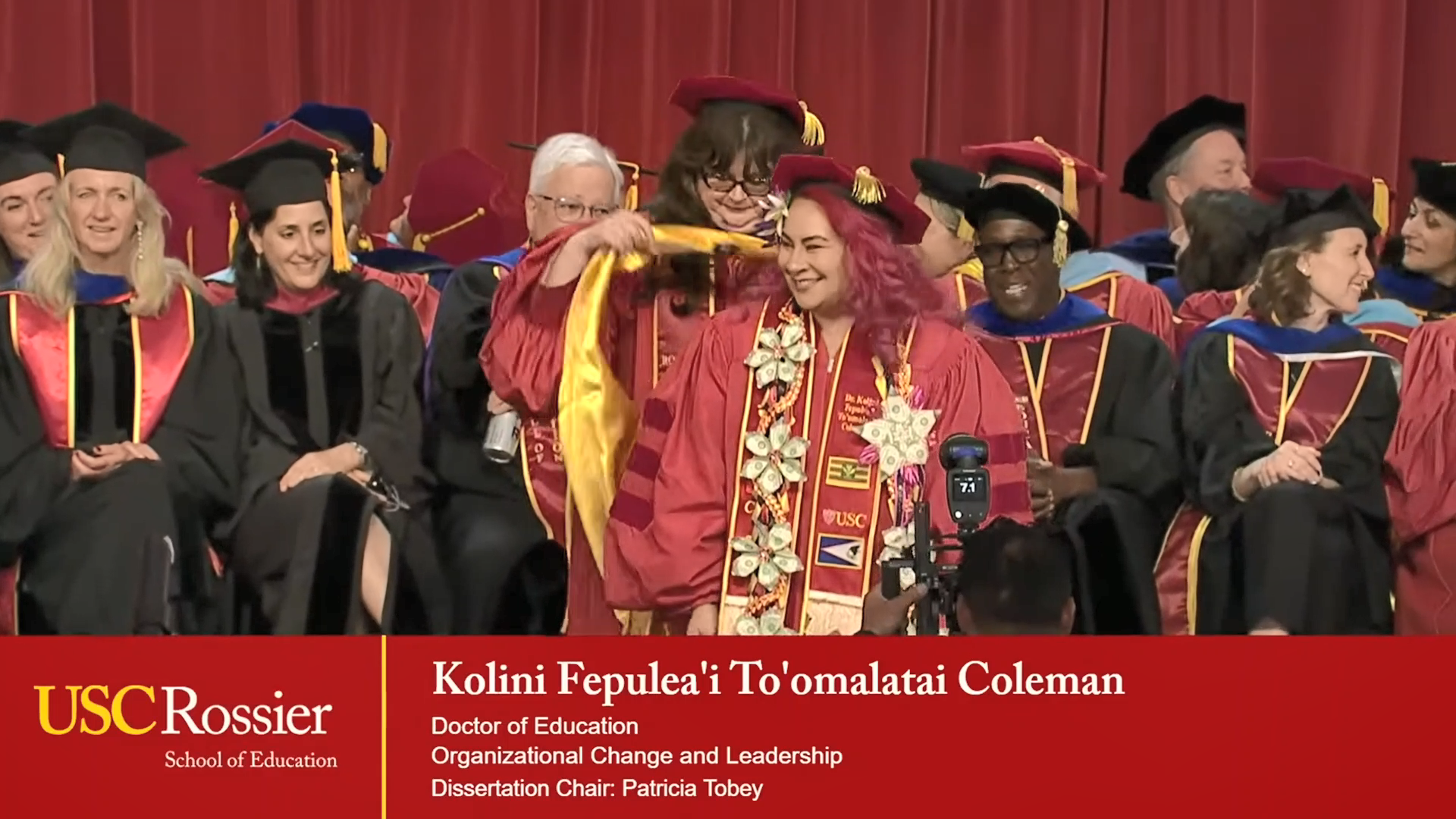
For Kolini Fepulea’i To’omalatai Coleman, crossing the commencement stage at USC was a huge personal milestone. But as a Polynesian, Native Hawaiian and Samoan graduate with a long, meaningful name, commencement name announcements had always been a source of anxiety. Not because she expected perfection, but because she had learned not to.
"I'm always nervous at commencement because I want to make sure that my name is pronounced correctly, especially with all my family in the crowd," she shared. "For Polynesian families, each part of our name is a part of a story and a legacy." That anxiety, familiar to so many graduates from diverse backgrounds, is exactly the problem Tassel's name announcement feature was built to solve.
Hearing It Before the Stage
When Kolini registered for commencement through Tassel's platform, the software let her hear exactly what her announcement would sound like. The experience was, in her words, straightforward and confidence‑building: "Hearing how it was going to sound beforehand really helped alleviate all of that anxiety. I knew it was going to be said correctly. So I had a lot more confidence crossing that stage."
When she finally walked across that stage, she was proud, grateful, and fully present in her moment. "I didn’t have to worry about how my name is going to sound because I've already heard it a million times," Kolini added.
The Comparison That Says It All
The week of Kolini's graduation, she attended two commencement ceremonies. Only the first ceremony she attended, USC’s Rossier School of Education ceremony, had used Tassel’s registration system and name announcement tools.
“I did have to say my own name for the Cultural Graduation that we had the next day.” This ceremony had live readers and phonetic cards to facilitate name announcements. “They were all looking at my card.” Kolini explained, “There were three name readers and they were kind of passing it back and forth to each other, so I was like, ‘Do y'all want me to say it?’"
To support, Kolini stepped in and announced her name herself before crossing the stage. A move that demonstrates how important it was for her that it be spoken accurately.
Kolini also shared that her spouse's doctoral commencement was that same week. His school did not use Tassel, and despite his best efforts, his name was not announced correctly. He had RSVP'd with exactly how he wanted his name said, but when he got his card at check‑in on the day of, none of that information had made it onto the card. He had to rewrite it all on the spot, and even then, it was still announced wrong. "He kept comparing his commencement to mine and even though we both had doctoral programs, it was just completely different vibes. He was like, 'Man, you know, they didn't do this like they did at yours,'" Kolini joked.
Pronouncing names that may be unfamiliar correctly, under pressure, and in front of a crowd, is a difficult task. This is the gap Tassel's tools are designed to close. When graduates can hear and approve their own name announcement ahead of the event, the uncertainty is removed before it ever becomes a problem, so announcers and graduates alike can simply be present for the moment.
On AI in Higher Education
Kolini brings a unique perspective to the conversation around AI in higher education. As both a graduate and a director who plans commencements herself, she understands the experience from every angle. She was fully aware that an AI voice was announcing her name, and that awareness only contributed to her surprise by how well it worked.
On her experience during her own stage crossing: “I was totally fine with it being an AI read name. The fact that I was able to hear it beforehand is what gave me the most confidence, because I knew that if it was a human reading it, regardless of how well I phonetically spell it, sometimes they still get it wrong."
The point isn't that AI belongs everywhere. It's that for graduates with names that have historically been butchered, mispronounced, or simply passed over, a tool that gets it right and creates equitable experiences for all graduates, might be worth it.
A Moment for Every Graduate
What makes Kolini's story resonate is not just that the technology worked. It's what it made possible. She walked slowly, let out a power fa'aumu, twirled in her Samoan and Native Hawaiian stoles, and beamed in the spotlight because she earned that moment.
"For all of the different pieces and sacrifices we made for those brief 15 to 20 seconds, I needed to make the most of it."
Commencement is not a logistical event. It is a rite of passage, and every graduate deserves to cross that stage feeling seen and celebrated in full. Kolini said it best:
"I wanted that moment to be able to call out to other Polynesians who are thinking about higher ed or maybe haven't seen themselves in those positions. It was really important for me that that moment just be everything that my ancestors ever dreamed of.”