
Only 4% of Graduates Purchased Photos, so BYU Marriott Made Them Free
Jessica DuBridge
May 04, 2026
The Problem With Graduation Photography
For decades, the graduation photography industry has run on a simple, extractive premise: capture the moment, lock it behind a paywall, and hope students have the means to pay. When a vendor only makes money if a student buys, prices keep climbing and access keeps shrinking.
The result is a quiet failure that most universities have simply accepted. Across the country, a majority of students walk across the stage and leave without a single professional photo to show for it. And schools lose the opportunity of having student stories and accomplishments that happened on their campus shared with the world.
Nicole Kooistra, Events Manager at BYU Marriott School of Business, knew this problem firsthand. Before partnering with Tassel, her team outsourced photography to Island Photography and GradImages. The outcome was telling: in 2025, of approximately 1,800 graduates, only 70 purchased photo packages. That means less than 4% of students left the ceremony with photo keepsakes. The college had tried to bridge the gap by covering the cost of one complimentary downloadable image per graduate (a handshake with the Dean), which saw strong engagement. But for the vast majority, the broader photography experience remained out of reach.
Nicole and her team had even explored hiring in‑house photographers, but distributing images efficiently at that scale felt more complex than beneficial. “As we began planning for the 2026 convocation, we did not intend to provide photography services—until learning about Tassel’s offering” Nicole shared.
A Better Model: Free for Students, Powerful for Schools
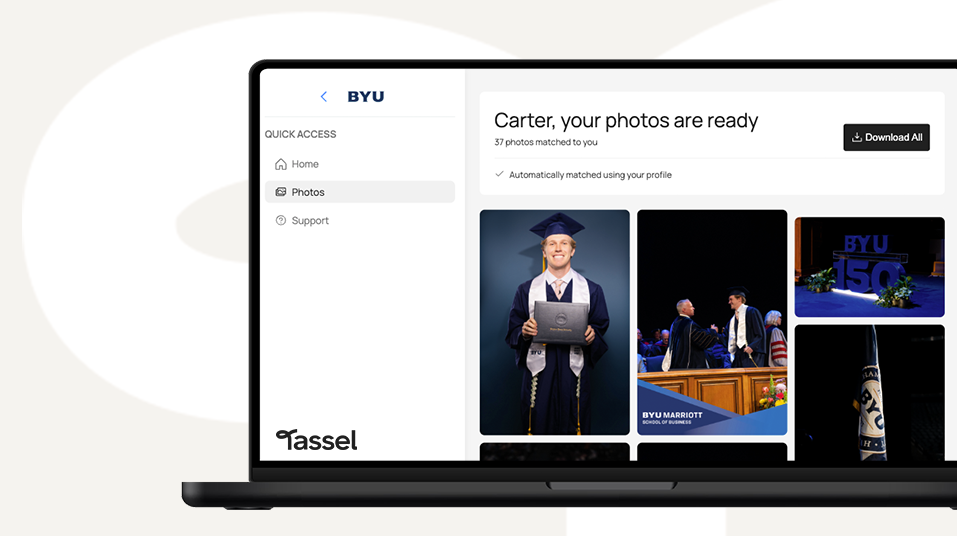
Tassel's approach flips the traditional model entirely. Rather than bringing in a vendor whose revenue depends on student purchases, the university hires photographers at an hourly rate. Every image gets uploaded to Tassel's platform. Students upload a selfie, and facial recognition software pulls every photo they appear in: their personal album, ready within 48 hours, at no cost.
“The photo offering from Tassel addressed all our concerns. We were committed to avoiding any additional costs for graduates, and this approach allowed us to deliver a stronger experience without the complications we had previously encountered with third‑party photography vendors” Nicole shared.
At the ceremony, the Dean told the crowd that graduates would receive their images within 48 hours of convocation, free of charge. The moment the surprise was announced, the room made itself heard. "The response was overwhelmingly positive,” Nicole said. “We could hear the crowd react. We also appreciated that even students who didn’t opt in to individual photos still received 5–7 general images from the event, ensuring everyone had something to remember the experience."
The numbers confirmed what the crowd already knew. The free photos pilot had a 76% opt‑in rate across both spring 2026 ceremonies. Out of the approx. 1,939 grads who RSVP’s yes, 1,475 graduates submitted a selfie to receive a matched photo album, with a 96.5% facial recognition match rate. Each graduate received an average of 22 photos (approximately 14 photos matched with facial recognition, and 8 institution‑curated ones). Only 52 students who uploaded a selfie were not matched, primarily due to issues like low‑quality images or attending a different ceremony than the one they registered for.
While it’s still a work in progress, Tassel is working to eliminate expensive photo packages and plots to profit off of graduates' accomplishments. Just near‑universal access to what should already be theirs.
Graduates felt it too. Here’s what Miranda Hulme, a BYU graduate who got her Masters in Accounting, had to say: “Getting my graduation photos so quickly for free was honestly one of the highlights of the whole experience. It made the day feel even more special knowing I’d have those moments captured and ready to share with my family and friends right away.”
A Light Lift to Make the Switch
Pivoting away from an established vendor model might sound complicated, but in practice, it wasn't. “There was a modest lift on our end, primarily around training the photographer and our staff to pose students effectively while keeping the tunnel photos moving efficiently,” Nicole shared. “That was the most significant adjustment beyond the initial hiring and onboarding of the photographer.”
Nicole also noted that the biggest learning from this first pilot was primarily communication. A handful of students reached out after the ceremony asking to upload their selfie once they better understood the offering. Nicole concluded that being more proactive upfront about how the photo matching works will only push opt‑in rates higher in future ceremonies.
Free Photos Benefit Everyone
Here's what the traditional vendor model costs universities beyond the student experience: it costs them their content.
When only 4% of graduates buy photos, only 4% of branded graduation moments ever get shared. The most emotionally resonant, most shareable content of the academic year simply disappears behind a paywall that almost no one crosses.
When students receive professional photos for free, within days of the event, right on their phones, they share them. Graduates are far more inclined to post and engage when the photos are high‑quality, fast, and free. Every image shared is authentic, student‑driven visibility for the university: your brand, your stage, your regalia, reaching exactly the audiences you want (families, future students, employers) without a single paid media dollar.
Nicole put it best: “Graduates are far less likely to purchase or share traditional photos from vendors like Island, so this model significantly increases the likelihood that images were shared. When students receive high‑quality photos quickly and at no cost, they’re much more inclined to post and engage—naturally extending BYU Marriott’s visibility and strengthening the overall brand through authentic, student‑driven content.”
The Bottom Line
Results speak for themselves. "This pilot delivered a high‑quality, no‑cost photo experience that increased student satisfaction and sharing, while reducing administrative burden and giving us greater control over the process." Nicole stated simply.
From 4% student photo package purchases to 76% free downloadable photo access, the shift speaks for itself. Tassel doesn't just want to improve the experience at BYU Marriott, we want every graduate to have access to free photos. This pilot proves that the old model was never the only option, it was just one that hadn’t been challenged. Until now.
-------------
A note on privacy and how the technology works
A common question when facial recognition is involved: what actually happens to student data? Tassel built its platform with that question at the center. When a student uploads a selfie to claim their photos, that image is used solely to match them to photos from their ceremony. It is not stored, repurposed, or added to any database. Once matching is complete, the biometric data is deleted. Students control the process from start to finish: participation is opt‑in, consent comes first, and any student can request provable deletion of their data at any time. Students who prefer not to participate still receive a set of general ceremony images from the event.
The platform is built to meet FERPA, GDPR, and the strictest biometric privacy regulations. Student data is never sold, never shared with third parties, and never held beyond its intended purpose. For universities, that means a better student experience without taking on new privacy risk.